
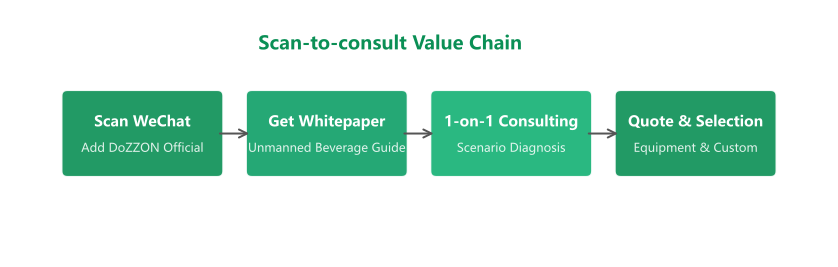
Scan to add DoZZON Official WeChat
Get the Unmanned Beverage Operations Whitepaper · 1-on-1 consulting
In one line: Fresh-grind, pre-packaged and soluble compared on cost, taste, operations and scenario fit — with a decision matrix and 2026-2028 outlook.
Key facts: 100+ models · 8 categories · 200+ IP assets · 100+ countries | OEM/ODM supported | 30–60 s per cup · ~2 m² footprint · CE / FCC / RoHS / LFGB / ISO 9001
DOZZON Tech Review Series | August 2026 · 9-minute read
In 2025, a hotel chain rolled out premium fresh-grind coffee machines on its guest floors — robotic arm, dual boiler, 15-bar extraction. On paper, top spec. Three months later, they pulled every unit and switched to pre-packaged capsule machines.
The reason wasn't taste — it was operations. Every day, staff had to visit 40 floors to empty puck bins, check bean-hopper humidity and unclog the occasional jammed grinder. One 18-floor hotel took two hours to clean. The ops team grew from 2 to 5 people, and most of the profit was eaten.
That story points to the key fact: no tech route is absolutely better — only better suited to a scenario. Fresh-grind, pre-packaged and soluble routes only make sense relative to a given cost structure, staffing constraint and guest expectation. This article sells none of them; it strips all three down so you can decide pragmatically.
| Dimension | Fresh-grind | Pre-packaged | Soluble |
|---|---|---|---|
| Principle | Whole beans ground on the spot → tamped → pressure-extracted → milk foam | Sealed single-serve capsule → pierced → pressure-extracted | Freeze-dried / spray-dried powder → dosed → water added & stirred |
| Ingredient cost / cup | ¥1.5–3.0 (bean grade) | ¥1.0–2.5 (brand tier) | ¥0.3–1.0 (freeze-dry grade) |
| Machine price | ¥40k–150k | ¥20k–80k | ¥15k–40k |
| Speed | 60–120 s/cup | 25–40 s/cup | 15 s+ |
| Maintenance | Daily puck-bin emptying + weekly deep clean | Refill water/capsules only; interior stays clean | Minimal: refill powder, flush lines |
| Consistency | Affected by humidity, bean state | Factory-sealed, cup-to-cup identical | Fixed ratio, stable flavor |
| Taste ceiling | Rich crema, full aroma | Close to espresso, slightly less fresh | Premium freeze-dried acceptable; classic types taste stale |
| Menu expansion | Coffee + milk-foam drinks + tea | Only pre-sealed flavors | Flexible categories but single flavor profile |
| Waste | Coffee grounds only (compostable) | Capsule recycling is the challenge | Light packaging waste |
Coffee has 800+ flavor compounds, mostly volatile aromatics. Within 15 minutes of grinding, over 60% of them evaporate. The whole value of fresh-grind is grinding at the moment of order — maximum aroma retention. A well-calibrated mid-to-high-end machine (stable 15-bar extraction, PID temperature control ±1 °C, ceramic flat burrs) can approach or exceed chain coffee-shop quality.
Three pain points no vendor has fully solved:
One line: taste ceiling, operations floor. High traffic plus real ops capability — you need both.
The decisive engineering benefit of capsules is zero residue. Grounds, dust and spent ingredients stay sealed in the capsule and are thrown away with it. The water lines only ever carry clean water — which is why a capsule machine can run 30 days without teardown and still beat a fresh-grind machine that went 3 days unwashed. It isn't "better tech"; it's physics — no residue, nothing to grow.
For distributed estates — 10+ machines across different sites — the ops gap is decisive. Restocking is carrying boxes and topping up water: one person covers 5–8 machines in a morning, versus 2–3 fresh-grind units for the same effort.
Every capsule is dosed and sealed in a factory-clean environment: grind size, tamping and extraction are all standardized. Whether you're in Shanghai or Lhasa, cup #1 or cup #10,000, the flavor is identical. Fresh-grind suffers "flavor drift" — season, humidity and bean batches all move the taste. Most drinkers won't notice; heavy coffee drinkers will. Capsules skip those variables entirely.
One line: the lowest-hassle route. 75-point taste, near-zero ops burden — currently the best fit for distributed operation.
Classic spray-dried instant has no place in any quality discussion — high-temperature spray drying destroys most flavor compounds; what you drink is caffeine, flavoring and sugar. But in 2024–2025, freeze-drying plus cold-brew concentrate restoration created a new species: specialty instant. Consumer brands proved people will pay ¥6–8 for a single-serve freeze-dried cup. Move that logic into an unmanned machine: 3–5 freeze-dried coffee powders plus a freeze-dried milk base; the user picks a flavor, the machine doses, adds water, stirs, serves — 15–20 seconds, near-zero maintenance.
Ingredient cost drops to ¥0.5–1.0 per cup, machine prices to the lowest band, and ops to almost nothing. At a ¥6–8 price point, gross margin exceeds 85%.
One line: lowest cost, weakest experience. Fits "better than nothing" scenarios; wrong for quality-driven markets.
| Your scenario | Recommended route | Why |
|---|---|---|
| Grade-A office lobby, 500+ visitors/day | Fresh-grind | High traffic dilutes ops cost; users demand quality and variety |
| Hotel guest floors, 20+ scattered points | Pre-packaged | Thin staffing; hygiene inside the machine matters; consistency first |
| Office pantry, ~200 staff | Pre-packaged | No dedicated ops; machine must not fail often; "tastes good" is enough |
| County-town supermarket entrance | Soluble (freeze-dried) | Price ceiling ¥6–8; near-zero ops; low investment, low risk |
| Railway station / airport | Fresh-grind or pre-packaged | Fresh-grind = quality premium; capsules = speed + stability |
| University canteen, 2,000+ students | Fresh-grind multi-drink | Coffee + milk tea + fruit tea on one machine; volume supports ops |
| Residential community | Pre-packaged or soluble | Limited ops coverage; pilot low-risk, upgrade after validation |
High-end machines march toward robotic arms, latte art and AI customization (¥150k–250k units for flagship venues). Low-end fresh-grind keeps losing ground to capsules and soluble — the ops disadvantage is structural. But one moat is irreplaceable: menu breadth. One-machine-many-drinks (coffee + milk tea + fruit tea + herbal) only exists on fresh-grind architecture. If you need one machine covering four dayparts and four drink categories, fresh-grind is the only answer.
Biodegradable capsule materials are the wildcard: if costs reach parity with conventional plastics within 2–3 years, the route gains brand legitimacy and policy tailwind; if plastic bans bite, its cost structure suffers. The second variable is co-branding — capsules naturally host "brand X exclusive" editions. A machine stocked with 5 recognized brands stops being "an unmanned coffee machine" and becomes "a multi-brand coffee station".
Spray-dried instant is a dead end — "sweet caffeinated water". Freeze-drying plus cold-brew restoration is the only upgrade path. If flavor restoration reaches 75–80% of fresh-grind at under 30% of its cost, soluble becomes genuinely competitive in price-sensitive markets.
Start with pre-packaged on 3–5 sites and validate demand, ops rhythm and cash flow. When a site clears 100+ cups a day and users start complaining about limited choice — upgrade that site to a multi-drink fresh-grind machine. When a site stays under 30 cups — downgrade to freeze-dried or pull out.
A tech route is not a belief; it's a tool. Pick the one that fits the current stage at the lowest cost, then let the data decide: upgrade, downgrade or withdraw.
DOZZON is an unmanned-retail solutions provider covering both fresh-grind multi-drink and pre-packaged routes. Its fresh-grind flagship line is in its fourth generation (coffee + milk tea + fruit tea + herbal in parallel, with AI interactive recommendation), while its capsule line focuses on distributed ops scenarios such as hotels and office pantries. Figures in this article come from DOZZON's own machine testing plus surveys of mainstream industry models, under unified evaluation standards and aligned scenario conditions. For detailed specs or a side-by-side demo, contact us via the website.
Scan to add DoZZON Official WeChat
Get the Unmanned Beverage Operations Whitepaper · 1-on-1 consulting
Conclusion: for unattended sites, capsule brewing wins — consistency comes from parameters, not from a person, and daily upkeep turns into a weekly refill. Fresh-ground suits staffed stores where grinding is part of the show.
| Dimension | Capsule brewing (unattended) | Traditional fresh-ground (staffed) |
|---|---|---|
| Upfront | Standard models by category, with canister and remote management | Grinder, water inlet and drainage, more installation work |
| Consistency | Fixed parameters, same recipe every time; 30–60 s per cup | Depends on bean state, grinder settings and the operator |
| Upkeep | Individually sealed capsules, enclosed path, ~15 min daily refill | Daily cleaning of lines and milk residue |
| Site fit | ~2 m², 220 V, no plumbing | Usually needs water in and drainage out |
| Compliance | Sealed capsules; food-contact and cleaning records traceable | Open canisters and fresh beans need tighter shelf-life control |
How to choose: pick capsule brewing for offices, transit hubs and parks where nobody is on site; fresh-ground is a nice experience layer for staffed stores. The two can coexist — mix them per machine and per site.
Consistency comes from parameters: 30–60 s per cup, ~2 m² footprint, 220 V with no plumbing, and per-machine telemetry for cups and faults.
To take it to a real site (office, mall, campus, park), send us the scenario and daily footfall and we will propose the configuration and numbers. Contact: sales01@dozzon.com | +86 185 0305 5366