What a Smart Coffee Kiosk Really Costs Over Twelve Months
In one line: Budgeting a smart coffee kiosk means writing down every recurring line before the order, then letting the site's own cup curve correct the sheet.
Key facts: Consumables scale directly with cups; with restock windows of every 2-3 weeks, the per-cup figure decides the whole year.
Three Threads Run Through Every Purchase
Choosing the smart coffee kiosk is easy until the site's power and drainage drawings arrive. This page keeps the routine in view, not only the hardware.
The Cost Lines Behind the Sticker
The sticker is one line of eight. Machine, placement, consumables, parts, power and connectivity, site fee, cleaning time and downtime make up the rest.
Written down separately, the lines show which lever actually moves the payback window of 3-8 months.
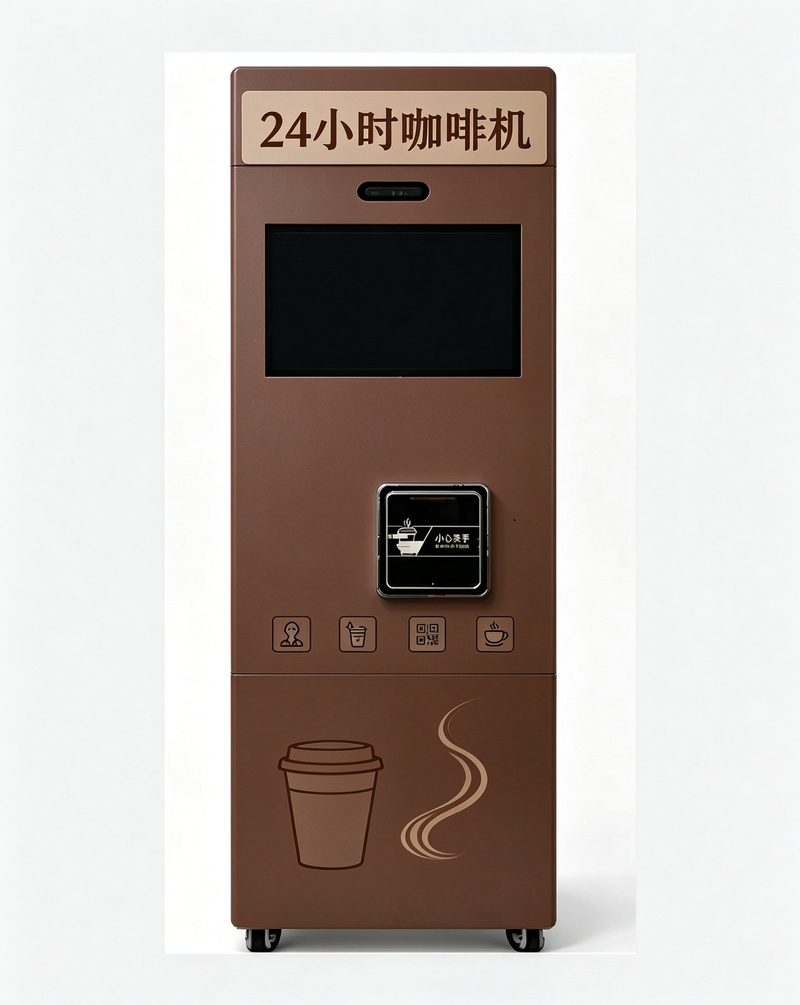
The Eight Cost Lines at a Glance
| Cost line | When it hits | How it scales |
|---|---|---|
| Machine (configured) | Before delivery | Fixed by the order |
| Placement and delivery | At installation | Per site |
| Consumables | Monthly | Directly with cup volume |
| Spare parts kit | One-time plus top-ups | With fleet size |
| Power and connectivity | Monthly | Flat per machine |
| Site fee or share | Monthly | With the venue agreement |
| Cleaning time | Weekly | With visit frequency |
| Downtime | Irregular | With service terms |
The Month the Building Emptied
The same face, four weeks running. A night porter on his round stops at an exhibition centre loading corridor, taps the screen twice, picks the same drink as always, and is walking away before the cup is full, and the pattern has stopped being a coincidence.
No promotion produced that habit. A machine that is always there, always stocked and always the same cup did it, which is a quieter kind of marketing than anything with a budget.
A site is not won on the first cup; it is won on the fifteenth. The restock note writes itself: the popular line is down one row.
The Cup That Does Not Fit
Cup dimensions look like a detail until a stack sits too tight in the chute or a lid will not seat. Machines are built around a nominal size, and the tolerance is smaller than most buyers assume.
Test the actual cup you intend to buy, not the one in the brochure, and test a full stack rather than a single cup. A mismatch discovered on installation day is a week of lost sales and an argument about whose specification was wrong.
Water Hardness and Filter Calendars
Hard water is a slow tax: it shows up in service calls long before it shows up in the cup. A strip test on day one and a filter calendar tied to the site, not to the model, keeps the tax low.
Log every filter change with a date and the readings around it. Two visits later the pattern is obvious, and the calendar stops being a guess.
What the Machine Cannot Tell You
A dashboard knows cups, codes and cash. It does not know that the corridor was closed for a week, that the host moved the bin, or that the regular who came every morning changed jobs.
The numbers explain what happened after the fact; the walkthrough explains why. A site read only from the dashboard drifts slowly and then suddenly, and the drift is always visible to whoever stands there for twenty minutes.
Complaints Logged, Complaints Answered
Write every complaint down with a date and a cause, even the trivial ones. The list becomes a fault profile within a quarter, and a fault profile is what turns an apology into a fix.
Answer within the day even when the answer is that someone is looking into it. A smart coffee kiosk that replies quickly is forgiven more often than one that is simply reliable.
The Sales Rep Who Knows the Route
A rep who has never restocked a machine will sell capacity that the route cannot serve. The result looks like a good deal and behaves like a permanent overtime bill.
Ask what a typical morning looks like, how many sites one person covers, and what happens when somebody is on leave. Answers that arrive without hesitation are worth more than any specification sheet.
Counting Footfall Without a Sensor
A camera-free way to size a site: count for twenty minutes at the worst time of day, then again at the best. The ratio between them says more about the venue than the daily total does.
Write down what people are doing while they wait, not just how many pass. Two hundred people walking past a cabinet convert worse than forty who queue beside it for four minutes.
What a Closed Site Costs
The same face, four weeks running. A saleswoman between two showroom appointments stops at the smoking-terrace door of an office tower, takes two - one now, one for the colleague minding the desk, and the pattern has stopped being a coincidence.
No promotion produced that habit. A machine that is always there, always stocked and always the same cup did it, which is a quieter kind of marketing than anything with a budget.
A site is not won on the first cup; it is won on the fifteenth. The restock note writes itself: the popular line is down one row.
Notes From the Field
Unattended retail rewards the person who shows up on a schedule. Machines do not need watching; they need intervals — cleaning intervals, restock intervals, ledger intervals — kept boringly on time.
The operators who last are rarely the loudest. They are the ones whose Wednesday route looks the same in week forty as it did in week one.
The Dashboard Number That Lies
Every dashboard has one number that is technically true and practically misleading: revenue before refunds, cups including test pours, uptime that counts a machine that cannot vend.
Pick the definitions once, write them down, and use the same ones in every conversation with a host. A number that changes meaning between meetings destroys trust faster than a bad month does.
Spare Parts and the First Repair
The first repair decides the relationship. Keep a small kit on the van - nozzle, seal set, payment module, fuse - and note which part failed, on which machine, at which hour.
A repair closed the same day is remembered as service. A repair that waits for a shipment becomes a story the host tells other hosts, and that story travels faster than any brochure.
The Price Change Nobody Announced
Raising a price by a small amount costs less than the two weeks of complaints that follow a badly explained one. The change is never the problem; the silence is.
Announce it where the customer already looks - the screen, the site notice, the host's own channel - and give a date. A price that moves without a sentence attached reads as an error, and errors get argued about at the counter.
Stock Counts and the Shrinkage Nobody Names
Sales data and capsule consumption drift apart, and the gap has three causes: a mis-scan, a wasted capsule during a fault, and theft that nobody wants to write down.
Counting one line every visit - always the same line - turns the drift into a number within a quarter. Counting everything occasionally produces a bigger number that explains nothing.
The Handover Note That Saves a Week
Every site accumulates small knowledge: the socket that trips, the door that sticks, the manager who wants a call before a visit. None of it is in the contract and all of it is in somebody's head.
One page per site, updated on each visit, turns that knowledge into an asset. The test of a good handover note is whether a stranger could restock the site without calling anyone.
The Depot Is the Business
Operators talk about sites and spend their money on the depot. The cabinet is a shop window; the room where capsules, cups, spares and the spare machine live is what decides whether a site can be served on a bad day.
Two numbers describe a depot: how many days of stock it holds, and how long it takes to build one site's load. Below three days of stock, every delivery delay becomes a stockout; above an hour of picking, the route stops scaling.
The smart coffee kiosk question is where the depot sits, not how big it is. Forty minutes from the furthest site is a working radius; two hours means the depot has quietly become a second business with its own fixed costs.
The Case for Fewer, Better Sites
A fleet of ten average sites costs more to serve than a fleet of six good ones: the same van hours, the same capsule handling, half the revenue concentration, twice the host relationships to babysit.
The walkthrough exists to say no. A site that fails two of the placement checks - dwell time, visibility, access hours - will fail them forever, politely, while consuming the same service capacity as a winner.
Pruning is not retreat. Every weak site traded up to a better corner raises the fleet's average, simplifies the route, and frees the operator's attention for the placements that compound.
Two Weeks of Nothing
The same face, four weeks running. A gym regular towel over the shoulder stops at a community clinic corridor by the pharmacy window, waits the forty seconds scrolling a phone, pockets the receipt without looking at it, and the pattern has stopped being a coincidence.
No promotion produced that habit. A machine that is always there, always stocked and always the same cup did it, which is a quieter kind of marketing than anything with a budget.
A site is not won on the first cup; it is won on the fifteenth. The site host walks past without looking up - the highest compliment a placement gets.
A Placement, Three Months In
The pilot at a hotel corridor by the lifts began as a favour to the site host and turned into the easiest arithmetic in the fleet: late-evening demand, nights outperform the average once the tour groups check in. When the second machine conversation started, the first month's ledger did most of the talking.
The interesting number is not the peak day; it is the worst weekday, because that is the one the rent has to survive. In this case the floor held, and a floor that holds is what lets an operator plan a second site.
What a Working Site Looks Like
Three months into a placement at a hotel corridor by the lifts, the pattern has settled: late-evening demand, and nights outperform the average once the tour groups check in. The menu has been trimmed twice - the dashboard ranked the lines, the bottom three went, and nobody wrote in to mourn them.
The quarter's lesson was about the restock hour, not the menu. Moving the visit ninety minutes earlier recovered the morning peak, and the peak turned out to be most of the site.
The Ledger Tells the Story
Three months into a placement at a wholesale market office row, the pattern has settled: early-morning trade, and the first two hours outsell the afternoon. The menu has been trimmed twice - the dashboard ranked the lines, the bottom three went, and nobody wrote in to mourn them.
The first month argued with the second and lost. What looked like a slow start was a queue forming in the wrong half hour - once the route moved the restock earlier, the same site sold the same cups with half the empty rows.
One Minute at the Machine
10:50, between meetings, a chess-and-cards room lobby. A site foreman counting change he no longer needs walks up to the smart coffee kiosk and holds the cup with both hands and says nothing, which is its own review. The cup arrives capped, a flat white still warm enough to notice on the walk back.
The site host walks past without looking up - the highest compliment a placement gets.
Multiply that minute by the hours the site is actually awake, and the placement argument writes itself: the machine is not competing with the cafe down the street - it is serving the traffic that never walks there.
Straight Answers to the Hard Questions
"Will people trust a drink made by a box?"
They trust the cup more than the counter when the cup is consistent. Capsule brewing means the tenth cup matches the first, and the cleaning sheet posted on the glass does more for confidence than any slogan.
"We tried a vending machine years ago and it was a disaster."
The difference is the telemetry. Stock, faults and sales report themselves now, so a machine that quietly fails gets noticed the same hour - not the following month.
"A machine like that must cost a fortune up front."
Less than the rent deposit for the counter it replaces. The machine is one of eight cost lines, and the payback window runs three to eight months at a site with real foot traffic - the worksheet in this series breaks all eight out.
"Doesn't it need plumbing and rewiring?"
A household power line and two square metres cover it. Most placements are standing and selling the same week the site agreement is signed.
A Week on the Route, Logged
- Monday - Route planned from the weekend's dashboard; the week's capsule order confirmed.
- Tuesday - Long route day - six machines, two top-ups flagged, one nozzle wiped twice.
- Wednesday - Midweek dip on the office sites; herbal line restocked at the clinic cluster.
- Thursday - Ledger exported and matched against capsule consumption; one gap investigated.
- Friday - The Friday visit happens before four, because after four the site is a queue and a machine that needs nothing.
- Saturday - Half-day route. The transit site runs hot, the office sites sleep, and the van gets its filters swapped.
- Sunday - Nothing scheduled. Alerts forwarded to the phone, one dashboard glance at noon, no wheels turned.
Twelve Months, Two Columns
| Month | What changes | What to do about it |
|---|---|---|
| Jan | Budget season: the annual consumables figure gets signed this month. | New-year footfall is slow to wake; keep the hot lines deep and the route tight. |
| Feb | Valentine week bends the coffee and milk-tea lines upward for ten days. | Short month, long queues on the 14th; order the dessert-adjacent capsules early. |
| Mar | Quarter close: reconcile the ledger and prune the menu bottom. | Spring footfall returns with the weather; fruit lines start their climb. |
| Apr | The first warm spell moves demand later in the day; watch the four o clock hour. | Rain weeks teach you which sites have indoor dwell; note them for the record. |
| May | Warm evenings extend the outdoor sites; chilled options earn their drawer space. | Holiday Mondays distort the weekly curve; compare like with like before judging a site. |
| Jun | Half-year service check: seals, nozzles, payment terminals. | Exam and event season bends public-hall sites; stock ahead of the dates. |
| Jul | Peak heat shifts demand; the curve moves later into the evening. | Office sites go quiet and tourist corridors take over; move the route, not the menu. |
| Aug | Capsule storage gets hot in August; check the stockroom before the shelf life does. | Use the lull for operator training and contract renewals. |
| Sep | Campus sites refill; the coffee line at eight in the morning comes back overnight. | Order winter capsule volumes early - the ramp catches late buyers. |
| Oct | The first cold snap is worth a route note: it usually front-loads the month by a week. | Autumn fairs and exhibitions fill the trade-hall sites. |
| Nov | Cold-weather peak builds; popular lines deserve a double buffer. | Darkness at five changes the traffic shape; the evening hour gains, the lunch hour thins. |
| Dec | Festive peaks everywhere except the empty offices; plan the route around both. | Close the ledger, thank the hosts, and let the dashboard write the next order. |
Notes I Keep Rewriting
There is a version of this business that runs on charm, and it works until the charming person takes a holiday. the cleaning sheet is the version that survives the holiday.
If I could send one paragraph back to my first order, it would be this - the cleaning sheet is not a purchase, it is a schedule, and the schedule is written in the ledger whether you look at it or not.
The machine never argues. It just records what you did about the first-month readings, and hands the record back at the end of the quarter.
How It Stacks Up
| The old way | What it costs | Where it fails | What the machine changes |
|---|---|---|---|
| Staffed counter | Wages every month, plus training and turnover | Open only as long as someone stands there | A smart coffee kiosk sells the hours the counter never could |
| Traditional coin vending | Coin floats, collection trips, notes that jam | Problems surface as complaints, weeks late | Payment and faults report themselves the same hour |
| Corner cafe | Rent, fit-out, staffed peaks | Fixed menu, fixed hours | Capsule range rotates at the restock visit, not by renovation |
| Line | What it pours | Where it fits best | Restock rhythm |
|---|---|---|---|
| Coffee machine | Espresso, americano, latte | Offices, hotels, waiting areas | Restock every 2-3 weeks |
| Milk tea machine | Milk tea and tea lines | High streets, campuses, food courts | Restock every 2-3 weeks |
| Juice machine | Fruit lines, chilled options | Gyms, cinemas, family venues | Restock every 2-3 weeks |
| Herbal tea machine | Herbal and traditional teas | Clinics, wellness floors, night sites | Restock every 2-3 weeks |
A Checklist Worth Printing
- Log the first month's cup curve against the plan
- Write the power draw and floor load into the site agreement
- Measure the walk from the door to the cabinet before delivery
- Confirm the delivery lift's depth before the van leaves
- Walk the route in the order the traffic allows, not the map
- Price one cycle of capsules before promising a payback figure
- Record the host's renewal date where the route can see it
- Review alerts quarterly and remove the noisy ones
- Fix the price list at launch and review it quarterly
- Test payment on site before the host's opening hour
- Note the site's quiet hours before scheduling a service visit
- Set a two-week buffer at the depot, not at the site
The Takeaway
Run the sheet, place the first unit, and let the first month of data argue for the second.
Common questions
Can I run twenty sites alone?
Up to a point - routes planned from live data are what make small fleets workable with one service person.
What does a cup actually cost?
Capsule plus cup plus a share of parts, power and cleaning - the per-cup figure is fixed with the supplier and held against invoices.
Rent or revenue share?
Flat rent suits steady sites, share suits unproven ones; hybrids split the difference.
What is the usual payback window?
The planning band is 3-8 months, set mainly by site quality and the local price of a cup.
Who prepares the site?
The host clears the spot and power; the operator brings levelling, testing and the first capsule load.
Is there a contract lock-in?
Placement terms vary by venue; trial periods with clear move-out terms are common and sensible.
What happens during a power cut?
The machine resumes when power returns; in-flight vends are voided and refunded per the posted rule.
Can the menu change without a technician?
Yes - capsule menus change at the restock visit; nothing on the machine needs touching.
Related machines
Related reading
- Picking the Spot: 24/7 Coffee Machine Placement Notes
- Remote Monitoring for a Coin-Operated Coffee Machine Fleet
- Shelf Life and Rotation for Capsule Coffee Machine Stock
- Commercial Coffee Dispenser Payments: Offline Cases and Reconciliation
Summary
Budgeting a smart coffee kiosk means writing down every recurring line before the order, then letting the site's own cup curve correct the sheet.
Send the site's foot-traffic notes and the capsule shortlist will follow.