What a 24/7 Juice Kiosk Really Costs Over Twelve Months
In one line: A 24/7 juice kiosk has eight cost lines, not one sticker; modelled over twelve months they show where the payback window of 3-8 months really sits.
Key facts: Machine, placement, consumables, parts, power and connectivity, site fee, cleaning, downtime - eight lines, and only one of them is the sticker.
Three Threads Run Through Every Purchase
Site visits for the 24/7 juice kiosk tend to end with the same three questions about stock, uptime and settlement. The order below is deliberate: decisions first, numbers second, service terms last.
The Cost Lines Behind the Sticker
The sticker is one line of eight. Machine, placement, consumables, parts, power and connectivity, site fee, cleaning time and downtime make up the rest.
Written down separately, the lines show which lever actually moves the payback window of 3-8 months.
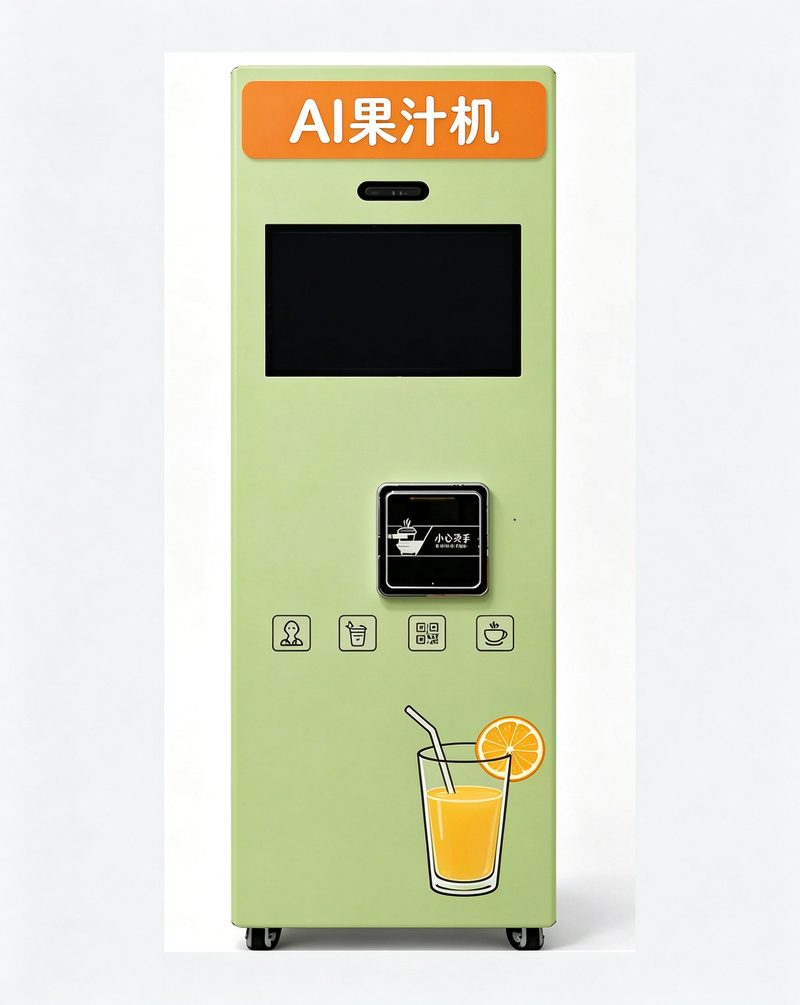
The Eight Cost Lines at a Glance
| Cost line | When it hits | How it scales |
|---|---|---|
| Machine (configured) | Before delivery | Fixed by the order |
| Placement and delivery | At installation | Per site |
| Consumables | Monthly | Directly with cup volume |
| Spare parts kit | One-time plus top-ups | With fleet size |
| Power and connectivity | Monthly | Flat per machine |
| Site fee or share | Monthly | With the venue agreement |
| Cleaning time | Weekly | With visit frequency |
| Downtime | Irregular | With service terms |
From the Service Route
The operator's van stops at a driving-school waiting shelter on a route that will cover six more machines before noon. The dashboard has already ranked the visit: stock fine, no faults, one line running low.
While the drawers are topped, a mother waiting out a clinic queue wanders up; the sale happens between two tasks, takes two - one now, one for the colleague minding the desk.
This is what unattended means in practice - not absence, but attention aimed exactly where the data says. By the time the queue reforms, the machine is already serving the next regular.
Water That Changes in Summer
Water is not a constant. Summer supply, a different treatment plant, or a building's own softener can shift hardness enough to change how coffee tastes and how fast a filter clogs.
Test hardness when the season turns, not only at commissioning, and move the filter schedule to follow the reading. A taste complaint in July is often a water report from May.
Price Ladder and Cup Sizes
Two sizes and three prices cover most sites: a small cup that undercuts the nearby cafe, a large one that beats it on volume, and a middle line that exists to make the large look reasonable.
The ladder should be readable in one glance. If a customer needs to compare four prices to choose, the menu is doing the operator's work for them, badly.
Choosing the First Site
The first site teaches the operator the business, so it should be chosen for learning speed rather than for size: close enough to visit weekly, forgiving enough to survive mistakes, busy enough to produce data.
A site twenty minutes away with modest traffic beats a landmark site two hours away, because the first one can be watched. Watching is what turns a placement into a method.
Renewal Is a Product Decision
The renewal conversation starts on the first day, not in month eleven. Every complaint resolved quickly, every report delivered on time, and every stockout avoided is a sentence somebody will remember when the term ends.
Walk into the renewal meeting with three numbers: cups served, uptime, and complaints closed. A host who has seen those numbers monthly does not need to be persuaded; a host who has seen nothing needs a discount.
The First Week of a New Site
The first week has one job: find out what breaks. Not how many cups sell - that number is still mostly curiosity - but which part of the routine does not survive contact with the building.
Write three lines every evening: what failed, who fixed it, how long it took. By Friday the pattern is visible, and the pattern is what a second site should be planned around.
The Small Consumables Nobody Counts
Cups, lids, stirrers and napkins never appear in a payback model and always appear in a month-end surprise. They are cheap per unit and expensive per thousand, and they are the first thing to run out when a site gets busy.
Count them the way stock is counted: a fixed par level per site, checked at every restock, ordered with the capsules rather than separately. A site that runs out of lids has effectively run out of drinks.
What the Van Sees at Seven
The operator's van stops at the morning queue inside a produce wholesale gate on a route that will cover six more machines before noon. The dashboard has already ranked the visit: stock fine, no faults, one line running low.
While the drawers are topped, two nurses sharing a ten-minute break wanders up; the sale happens between two tasks, holds the cup with both hands and says nothing, which is its own review.
This is what unattended means in practice - not absence, but attention aimed exactly where the data says. No one needed help, which is the entire point.
Security and Vandalism
Unattended does not mean unobserved. The sites that suffer least are the ones where someone's job includes looking at the machine - a receptionist, a security desk, a cleaner on a fixed round.
Physical measures are cheap: a bolted base, a camera pointed at the queue rather than the machine, and a light that keeps the corner from becoming private after dark.
When the Host Asks for a Discount
A host asking for a higher share is usually testing whether the number on the table was built or guessed. Answering with a concession teaches them it was guessed.
The better reply is arithmetic: here is the cup volume the site needs for the current share to work, here is what happens to it at the share you are asking for, and here is the trial period that will tell us which is right. Discounts are cheap when the volume is real and expensive when it is not.
Payment and Reconciliation Basics
Every sale is logged against a timestamp and a method, so the monthly settlement is a report rather than an argument.
- QR scan-to-pay covers the standard flow; each order carries its own reference
- Export the ledger monthly and match it against capsule consumption
- Agree in advance who refunds failed vends and how fast
Insurance and Liability in Plain Terms
Ask three questions before signing: whose policy covers the cabinet against damage, whose covers a customer who spills a hot drink, and what the host's own insurer requires in writing. Most answers arrive within a week if asked early.
Because a 24/7 juice kiosk holds no cash, the theft conversation is shorter than it once was - the till is a database. The liability conversation stays, and it is settled by one page rather than by goodwill.
Queues, Layout and the Second Cabinet
A single cabinet serves about three customers a minute at its best; beyond that the queue becomes the advertisement nobody wants. The second unit is justified by queue length, not by revenue alone.
Place the second cabinet beside the first rather than across the room. Two machines in one sightline share a queue, a restock trip and a fault log; two across a lobby share nothing but a landlord.
Compliance and Site Etiquette
Quiet hours, tidy frontage and clear contact details keep hosts happy; none of it is complicated, all of it is noticed.
Keep the machine's paperwork - model, power, hygiene sheet - on file for venue audits.
When the Host Changes Their Mind
Hosts change: a new manager, a new owner, a new policy from head office. The machine that was welcome in March is asked to move in September, and the reason given is rarely the real one.
The protection is not the contract clause; it is the monthly report. A host who has watched cups and complaints every month knows what the machine does, and a manager inheriting that file inherits the argument for keeping it.
When the request comes anyway, ask for thirty days and a chance to fix the specific complaint. Half the time the complaint is fixable - noise, light, a queue at nine - and the 24/7 juice kiosk that survives is a site that will not raise it again.
Reading a Dashboard Like an Operator
Three views carry the week: hourly sales against the site's curve, stock depth per capsule line, and the fault log with timestamps. Everything else is decoration until one of those three moves.
The art is in the comparison. A site selling forty cups a day means nothing alone; against last week it is a trend, against the site next door it is a verdict, against the same week last season it is a menu decision.
Operators who annotate the dashboard - a festival, a roadwork, a host's renovation - build an asset no spreadsheet of raw numbers provides: a memory of why the curve bent, which is what next year's plan is made of.
A Cup in the Middle of a Workday
A rainy 3 in the afternoon at a library reading-room vestibule. The queue at the coffee counter downstairs is eight deep; the 24/7 juice kiosk has three cups' worth of waiting in it, and no queue.
A delivery rider helmet in hand taps the screen twice, picks the same drink as always, and is walking away before the cup is full, then goes back upstairs with the cup still in hand - a two-minute errand that a staffed counter would have turned into ten.
Speed is not a luxury feature here; it is the placement's whole economics. Nobody photographs it; the machine has simply become part of the floor plan.
A Placement, Three Months In
The pilot at a coach station waiting row began as a favour to the site host and turned into the easiest arithmetic in the fleet: departures-board waves, each delayed departure buys another round of cups. When the second machine conversation started, the first month's ledger did most of the talking.
What the site taught was patience with a shape. Weeks one to three looked like a verdict; weeks four to twelve were the actual answer, and the answer was better than the verdict.
What a Working Site Looks Like
Three months into a placement at a coach station waiting row, the pattern has settled: departures-board waves, and each delayed departure buys another round of cups. The menu has been trimmed twice - the dashboard ranked the lines, the bottom three went, and nobody wrote in to mourn them.
The ledger and the walkthrough told different stories for a month. The ledger said demand; the walkthrough said a queue at the wrong hour. The walkthrough was right, and the fix cost nothing.
The Ledger Tells the Story
Three months into a placement at a wholesale market office row, the pattern has settled: early-morning trade, and the first two hours outsell the afternoon. The menu has been trimmed twice - the dashboard ranked the lines, the bottom three went, and nobody wrote in to mourn them.
Half the value came from what was removed: two slow lines, one noisy alert, and a promotion that discounted the only product everybody bought at full price anyway.
The Two-Minute Break That Pays
A hot noon under the awning at a bus terminal mezzanine near the ticket gates. The queue at the coffee counter downstairs is eight deep; the 24/7 juice kiosk has three cups' worth of waiting in it, and no queue.
A security guard off the midnight shift holds the cup with both hands and says nothing, which is its own review, then goes back upstairs with the cup still in hand - a two-minute errand that a staffed counter would have turned into ten.
Speed is not a luxury feature here; it is the placement's whole economics. The restock note writes itself: the popular line is down one row.
Straight Answers to the Hard Questions
"Doesn't it need plumbing and rewiring?"
A household power line and two square metres cover it. Most placements are standing and selling the same week the site agreement is signed.
"Sounds like a headache to restock."
The restock route runs every two to three weeks per machine on normal demand, sized by the dashboard rather than by guesswork. One van, one morning, ten sites.
"Will people trust a drink made by a box?"
They trust the cup more than the counter when the cup is consistent. Capsule brewing means the tenth cup matches the first, and the cleaning sheet posted on the glass does more for confidence than any slogan.
"Is the tea or coffee actually any good?"
Good enough that the repeat rate, not the first sale, pays for the placement. The capsule range covers espresso, milk tea, fruit and herbal lines, so the regulars settle in and the curious keep sampling.
A Week on the Route, Logged
- Monday - Dashboard review first: two sites ran hot over the weekend, so their rows go to the front of the van.
- Tuesday - Route day proper. A payment terminal at the second stop needed a restart; the log records the minute it happened.
- Wednesday - Halfway check on capsule depth; one line is running ahead of plan and earns a second row next visit.
- Thursday - Books day. The monthly figure gets compared to the site's own count, and the two agree within normal wastage.
- Friday - Peak-site visit before the evening rush; contact card replaced at one unit.
- Saturday - Weekend shift: fewer sites, more cleaning. Two drip trays, one filter, and a machine that looks new again.
- Sunday - Silent day by design - alerts on, phone on, van parked.
Twelve Months, Two Columns
| Month | Traffic pattern | Route decision |
|---|---|---|
| Jan | New-year footfall is slow to wake; keep the hot lines deep and the route tight. | Budget season: the annual consumables figure gets signed this month. |
| Feb | Valentine week bends the coffee and milk-tea lines upward for ten days. | Short month, long queues on the 14th; order the dessert-adjacent capsules early. |
| Mar | Exam season starts on campuses; the library site stops being a quiet placement. | Quarter close: reconcile the ledger and prune the menu bottom. |
| Apr | The first warm spell moves demand later in the day; watch the four o clock hour. | A good month to trial one new capsule line per machine. |
| May | Warm evenings extend the outdoor sites; chilled options earn their drawer space. | Mid-year route review: cut the weakest ten percent if the ledger says so. |
| Jun | Half-year service check: seals, nozzles, payment terminals. | The first genuinely hot week tells you whether the chilled lines were sized right. |
| Jul | Peak heat shifts demand; the curve moves later into the evening. | Office sites go quiet and tourist corridors take over; move the route, not the menu. |
| Aug | The slowest office month; the tourist corridors carry the fleet instead. | Capsule storage gets hot in August; check the stockroom before the shelf life does. |
| Sep | Campus sites refill; the coffee line at eight in the morning comes back overnight. | Back-to-routine week is the second new year; footfall snaps back fast. |
| Oct | Autumn fairs and exhibitions fill the trade-hall sites. | The hot-drink golden window opens; the curve steepens week on week. |
| Nov | Cold-weather peak builds; popular lines deserve a double buffer. | Year-end host meetings: renewals, shares, next-year placements. |
| Dec | Close the ledger, thank the hosts, and let the dashboard write the next order. | The last week is dead in offices and frantic in transit; stock for one and rest for the other. |
From the Operator's Notebook
The dashboard is honest, the host is honest, and both are approximate. the cleaning sheet is what turns two approximations into a decision.
Nobody warns you that the hard part is not buying the machine. It is the alert settings, done the same way in month nine as in month one.
The machine never argues. It just records what you did about the ledger discipline, and hands the record back at the end of the quarter.
How It Stacks Up
| The old way | What it costs | Where it fails | What the machine changes |
|---|---|---|---|
| Staffed counter | Wages every month, plus training and turnover | Open only as long as someone stands there | A 24/7 juice kiosk sells the hours the counter never could |
| Traditional coin vending | Cash handling, change runs, slot jams | No telemetry; faults found by complaint | Every sale logged, every fault alerted |
| Corner cafe | A lease, a build-out, a barista roster | Menu changes mean reprinting and retraining | The menu changes when the capsule order does |
| Line | What it pours | Where it fits best | Restock rhythm |
|---|---|---|---|
| Coffee machine | Espresso, americano, latte | Corporate floors, hotel corridors | Restock every 2-3 weeks |
| Milk tea machine | Milk tea and tea lines | High streets, campuses, food courts | Restock every 2-3 weeks |
| Juice machine | Fruit lines, chilled options | Gyms, leisure, transit | Restock every 2-3 weeks |
| Herbal tea machine | Herbal and traditional teas | Clinics, wellness floors, night sites | Restock every 2-3 weeks |
A Checklist Worth Printing
- Set stock thresholds on the dashboard before day one
- Confirm who empties the bin beside the cabinet
- Check signage faces the waiting area, not the wall
- Write the power draw and floor load into the site agreement
- Decide who owns the cups before the first order
- Compare the monthly ledger to the site's own count once a quarter
- Measure the walk from the door to the cabinet before delivery
- Price one cycle of capsules before promising a payback figure
- Confirm the delivery lift's depth before the van leaves
- Check the pickup slot height against the host's accessibility notes
- Log the first month's cup curve against the plan
- Review alerts quarterly and remove the noisy ones
The Takeaway
The plan that survives contact with a busy site is the one written with the operator, not merely for them.
Common questions
What does a cup actually cost?
Capsule plus cup plus a share of parts, power and cleaning - the per-cup figure is fixed with the supplier and held against invoices.
How often do filters change?
By litres, not by date: the interval is set from measured hardness and logged on the sheet.
Can I run twenty sites alone?
Up to a point - routes planned from live data are what make small fleets workable with one service person.
What happens during a power cut?
The machine resumes when power returns; in-flight vends are voided and refunded per the posted rule.
Does the machine need a water line?
Many units run without plumbing; confirm the water arrangement for the specific model during placement prep.
How long does installation take?
On a prepared site, commissioning is typically finished in under an hour: position, power, network check and a run of test cups.
Is there a contract lock-in?
Placement terms vary by venue; trial periods with clear move-out terms are common and sensible.
What happens if a flavour runs out?
The dashboard flags the line before it empties; the next route carries the buffer.
Machines this article refers to
Related reading
- Running an Unmanned Juice Machine Day to Day
- Placement Playbook for the Commercial Juice Vending Machine
- Unattended Juice Corner Operations: A Practical Routine
- Picking the Spot: Capsule Juice Machine Placement Notes
Summary
A 24/7 juice kiosk has eight cost lines, not one sticker; modelled over twelve months they show where the payback window of 3-8 months really sits.
Request the spec sheet and the TCO worksheet together - they read as one document.